Lighting Requirements in Switzerland County, Indiana
Lighting Regulations in Switzerland County, Indiana: Preserving Rural Heritage While Meeting Modern Needs
Introduction
Nestled along the scenic Ohio River, Switzerland County holds a special place in Indiana's history. Founded in 1814 by Swiss immigrants, the county is home to the historic town of Vevay, which is listed on the Indiana State Historic Register. This area is distinguished by its unique European heritage, with the Dufour brothers establishing America's first commercial vineyard and winery after purchasing land in 1802.
The county's approach to lighting regulations reflects a careful balance between preserving its historic character and meeting contemporary needs. While Switzerland County doesn't have extensive lighting regulations compared to more urban areas, the requirements that do exist serve important purposes in maintaining community standards and respecting the area's rural and historic nature.
Quick Reference Guide to Switzerland County Lighting Regulations
- Board Approval Required: Most commercial and special-use outdoor lighting needs Board approval
- Glare Restrictions: No lighting may produce glare beyond property lines
- Parks Illumination: 0.3 foot-candles for pathways, 0.6 foot-candles for hazardous areas
- Parking Areas: Must use shielded fixtures directed away from adjacent properties
- Swimming Pools: Lights must be arranged to direct illumination away from neighboring properties
- Sign Illumination: No emergency light resemblance; illumination should be appropriate for readability
- Adult Businesses: Minimum 2 foot-candles interior illumination; 1+ foot-candle for parking areas

General Glare and Nuisance Prevention
Property Boundaries and Light Trespass
Switzerland County places significant emphasis on preventing light from becoming a nuisance to neighbors. The code clearly states that no use shall produce heat or glare in such a manner as to be a nuisance or create a hazard perceptible from any point beyond the lot lines.
Commercial Enterprises and Neighboring Properties
For restricted commercial farm enterprises, the regulations specify that operations shall not "cause the emission of smoke or particulate matter or cause any undue vibration or excessive glare or heat beyond the boundaries of the property."
Public Nuisance Prevention
The regulations further emphasize that "no operation, activity or structure shall cause heat or glare in such a manner as to be a public nuisance at or beyond any residence or business district boundary."
Board Approval Requirements
Commercial and Special Uses
A recurring theme in Switzerland County's lighting regulations is the requirement for Board approval. For numerous special uses, the code consistently states: "Outdoor advertising signs and outdoor artificial lighting shall be approved by the Board."
Facilities Requiring Board Approval
This requirement applies to diverse facilities including:
- Cemeteries and crematories
- Assembly halls and grounds
- Filling stations and car washes
- Roadside restaurants
- Outdoor commercial recreational enterprises
- Outdoor theaters
- Heliports and transmission towers
- Wholesale produce terminals
- Seasonal and year-round produce stands
- Riding stables
- Public parks and recreational facilities
.jpg&w=3840&q=75)
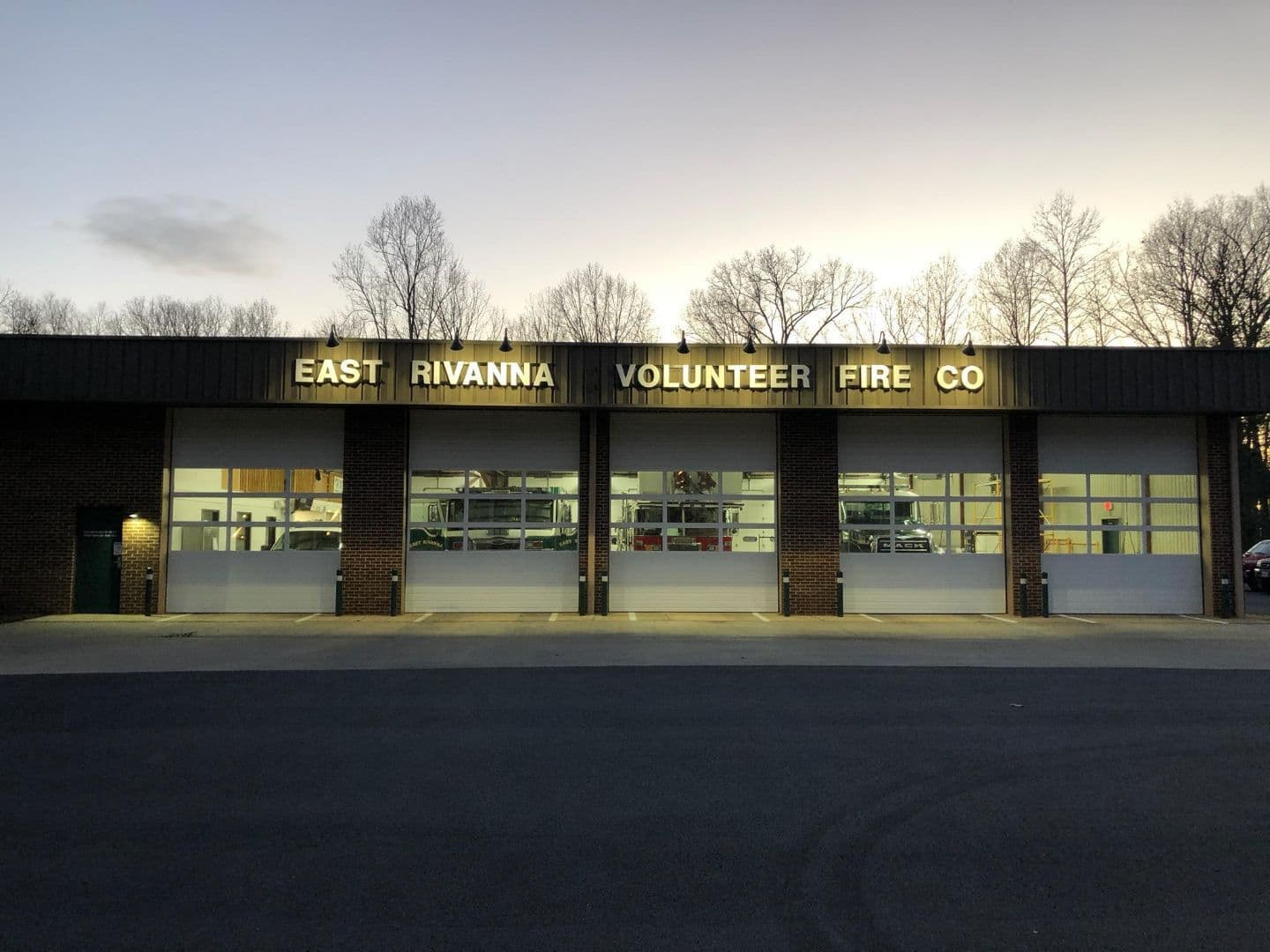
East Rivanna Volunteer Fire Co.
Keswick, Virginia
Specific Illumination Standards
Parks and Public Spaces
Switzerland County provides detailed illumination requirements for parks:
- Interior driveways: Average illumination of 0.3 foot-candles
- Hazardous areas (steps, ramps): Average illumination of 0.6 foot-candles
- Exterior park lights: Must be "located and shielded as to prevent direct illumination of any areas outside the park"
Adult Businesses
The code provides specific illumination requirements for adult businesses:
- Interior spaces: Minimum maintained horizontal illumination of 2 foot-candles
- Parking areas and building entries: Minimum maintained horizontal illumination greater than 1 foot-candle within 100 feet of entrances
- Security: On-site security program including interior and exterior lighting plans
Parking Areas
For parking illumination, the regulations state:
- Lighting facilities must be "located, shielded, and directed upon the parking area"
- Must not "reflect or cause glare onto adjacent properties"
- Must not "interfere with street traffic"
- Bare unshaded bulbs are specifically prohibited
Residential and Special Use Lighting
Professional Offices in Residences
For homes containing professional offices, the regulations specify that "there shall not be used any nameplate or sign nor any artificial lighting or any display that will indicate from the exterior that the dwelling is being utilized in part for any purpose other than that of a dwelling."
Swimming Pools
For swimming pools, the regulations clearly state that "lights to illuminate any pool shall be so arranged and shaded as to reflect light away from adjoining premises and streets."
Flood Lighting
The code addresses flood lighting with this straightforward requirement: "Any flood lights or other lighting shall be directed upon the premises and shall not be detrimental to adjacent properties."
Signage Illumination
Emergency Light Resemblance
The regulations prohibit certain types of animated lighting: "No rotating beam, beacon, or flashing illumination resembling any emergency lights shall be used in connection with any sign display".
Appropriate Illumination Levels
For general sign illumination, the code specifies that "illumination of signs, where not specifically prohibited by this chapter, should be at a level consistent with adequate identification and readability."
Business Signs
For business and advertising signs:
- May be illuminated unless specified otherwise
- Light reflectors shall not extend more than 12 feet from the face of the sign
- Direct rays of light shall not beam upon any part of adjoining property
Prohibited Illumination
The regulations specifically note:
- Signs located on awnings shall not be illuminated
- "No lights utilizing an attracting device or lights on stringers of unshielded incandescent lamps or attention attracting lighting from apparatus of a type used by emergency vehicles shall be permitted on the premises."
Property Identification
Switzerland County requires that:
- Property owners must display officially assigned numbers in a location easily visible from the street
- Numbers may be placed on outside lights (as well as mailboxes or posts)
- Numbers must be a minimum of three inches in height
- Numbers must be made of durable, weather-proof material
- Numbers must contrast in color from their background for easy visibility

What Property Owners Should Know
Residential Considerations
If you're a homeowner in Switzerland County, the regulations are relatively straightforward. The main concerns involve ensuring that any lighting does not create glare or nuisance conditions for your neighbors. Lamp posts are permitted in yards without requiring special permits.
Business Owners
For commercial property owners, more regulations apply. Most outdoor lighting requires Board approval, especially for special uses. When planning your lighting, remember that it must be directed and shielded to prevent spillover onto neighboring properties.
Historic Considerations
Given Switzerland County's rich historical heritage, especially in Vevay, property owners should consider how lighting choices impact the historic character of the area, even when specific regulations might not address every situation.
Supporting Switzerland County's Lighting Vision
Bock Lighting, with roots dating back to 1918 in Northeast Ohio, understands the importance of balancing modern lighting needs with preservation of historical character. We appreciate Switzerland County's approach to maintaining its unique European heritage while accommodating contemporary requirements.
Our experience working with communities that value their historical integrity allows us to serve as a resource for property owners navigating lighting regulations. We understand that in places like Switzerland County, lighting needs to complement the architectural heritage rather than detract from it.
As lighting professionals familiar with the balance between safety, functionality, and historical aesthetics, we're committed to supporting communities in preserving their distinctive character. Our understanding of regional architectural styles, particularly those with European influences that are so important to Switzerland County's identity, informs our approach to lighting solutions.
The rich history of Switzerland County, from its Swiss immigrant founders to its distinction as America's first commercial wine-producing region, creates a unique context for lighting considerations that we recognize and respect.
Conclusion
Switzerland County's lighting regulations, while not extensive, effectively address the most important aspects of community lighting standards. The focus on preventing nuisance conditions, requiring Board approval for special uses, and establishing specific illumination standards for certain applications helps maintain the county's rural character and historical charm.
Property owners should particularly note the emphasis on preventing light trespass beyond property boundaries and the requirement for shielded fixtures. For those undertaking special uses, early consultation with the Board regarding lighting plans is essential.
As Switzerland County continues to balance preservation with progress, these lighting regulations serve an important role in maintaining the quality of life and distinctive character that make this historic river community special.